Cultural Geography 3rd Edition Bju Press Chapter Test Google Review
Cultural Geography, fourth edition
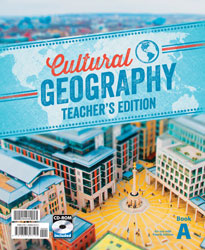
The fourth edition of BJU Press's Cultural Geography text deals with both geography and cultures as yous might estimate from the championship. The book has been significantly updated from previous editions, reflecting the huge geographic and cultural shifts that are continually occurring.
Written for ninth graders, the student text is a large book (over 600 pages) attractively designed with many full-colour maps and photos. It consists of 24 chapters arranged into nine units. Maps, a glossary and an index are at the end of the book.
The book begins with a foundational overview of the biblical view of cultures, including man's relation to the surroundings. The second chapter is an introduction to geography and its applications through the ages also equally to various types of maps. The third chapter addresses the geological history of the earth from a creationist betoken of view, including discussion of Noah'due south overflowing and its effects. Information technology also covers basic terminology, major landforms, major bodies of water, the makeup of the earth's chaff, rivers, plate tectonics, climate, vegetation, biomes, and other foundational topics.
The quaternary chapter looks at industry's apply of natural resource while the fifth chapter discusses some key elements of cultures: languages, religion, and government.
The remainder of the book divides the world into regions for study. Chapters are grouped into units that cover continental areas. For example, Latin America, the fourth unit, includes chapters on Middle America (i.east., Mexico, Central America, and the West Indies) and South America. The content in every chapter ranges broadly through geography and civilisation oft making connections to historical events.
As is typical of BJU Press textbooks, there are section review questions within each chapter and boosted questions at the terminate of each chapter. Answers are in the teacher's edition. "Let's Get Exploring" sections in most chapters address map and chart reading skills with interpretive questions for students to answer. For instance, the "Let's Go Exploring" inset in chapter ten has a map of Latin America showing various types of land usage such every bit crop farming, subsistence farming, manufacturing and trade, and ranching, forth with the location of natural resources such as gold, iron, and petroleum. Five questions require students to analyze the map and draw some conclusions. The final question asks to students, "Which nation has the greatest variety of state use?" (p. 233).
Other inset boxes address special geographical sites of interest and interesting topics that don't fit the period of the text such as Gypsies, "Mennonites in Belize," and immigration bug.
The text is written from a Christian worldview. While it includes discussion of other major earth religions, it examines them from a Protestant perspective. A few of the questions at the finish of the chapters ask the educatee to evaluate information about the various countries in the lite of Scripture. Some of the religious content springs from discussions suggested in the bottom margin of the instructor's edition rather than from the pupil text, so students reading the text on their own will miss those topics.
The Student Activities Manual works manus in hand with the text. It has questions, map work, charts to complete, and enrichment activities that go beyond the pupil text. The Activities Manual has its own answer key.
The instructor's edition consists of two spiral-spring books that contain reduced images of the student text pages. The instructor's edition serves as your answer key, but it as well provides a great deal of helpful information for those who want to directly teach the course. Information technology has the religious word topics mentioned above also every bit other give-and-take questions with some suggested responses or aspects to bring up. It also has suggestions for multi-media resources you might employ, and it ties in pages to be completed in the Pupil Activities Transmission. A Teacher's Toolkit CD-ROM that is included at the back of the first volume of the teacher'due south edition offers additional resources that volition be most useful to those educational activity group classes.
I encourage you to take advantage of the extra resource and suggestions in the instructor'south edition. I realize that some homeschooling parents will cull to have their students complete this course on their own, and that volition piece of work. It just isn't likely to be every bit interesting if you leave out the discussions and extra activities.
The Cultural Geography Subject Kit includes the student text, teacher'south edition, activities manual, activities manual answer key, tests, and tests answer key. The student text is likewise available as an etextbook.
This text is suggested for apply in ninth form. While it could be used a different year in high school, it makes sense to use it before studying earth history since it gives students underlying geographical knowledge which and so makes it easier to empathise the dynamics of world history.
Pricing Information
When comparison prices announced, delight keep in listen that they are subject area to change. Click on links where available to verify cost accuracy.
Click here to purchase directly from the publisher using our chapter link. This helps support this website.
You might want to check out the premade lesson plans from Homeschool Planet that are available for Cultural Geography. (These are found under the BJU Press History page at Homeschool Planet.) You can sign up for a xxx-twenty-four hours Costless trial.

Source: https://cathyduffyreviews.com/homeschool-reviews-core-curricula/history-and-geography/geography/cultural-geography-fourth-edition

Post a Comment for "Cultural Geography 3rd Edition Bju Press Chapter Test Google Review"